
UPSC ESE 2027 Notification: About 480 Engineering Services Vacancies, Prelims on 31 January 2027
The Union Public Service Commission has released Examination Notice No. 02/2027-ENGG. for the Engineering Services Examination (ESE) 2027. ESE recruits engineers to Group A and Group B technical services in the railways, defence, telecom, water resources, power and other central departments. About 480 vacancies are expected, including 19 for Persons with Benchmark Disabilities. Online applications opened on 16 September 2026 and close on 6 October 2026 at 6:00 PM. The Preliminary exam is on 31 January 2027 and the Main exam on 18 June 2027. This page covers the official notice: the four engineering categories, eligibility, fee, the three-stage scheme and the syllabus heads.
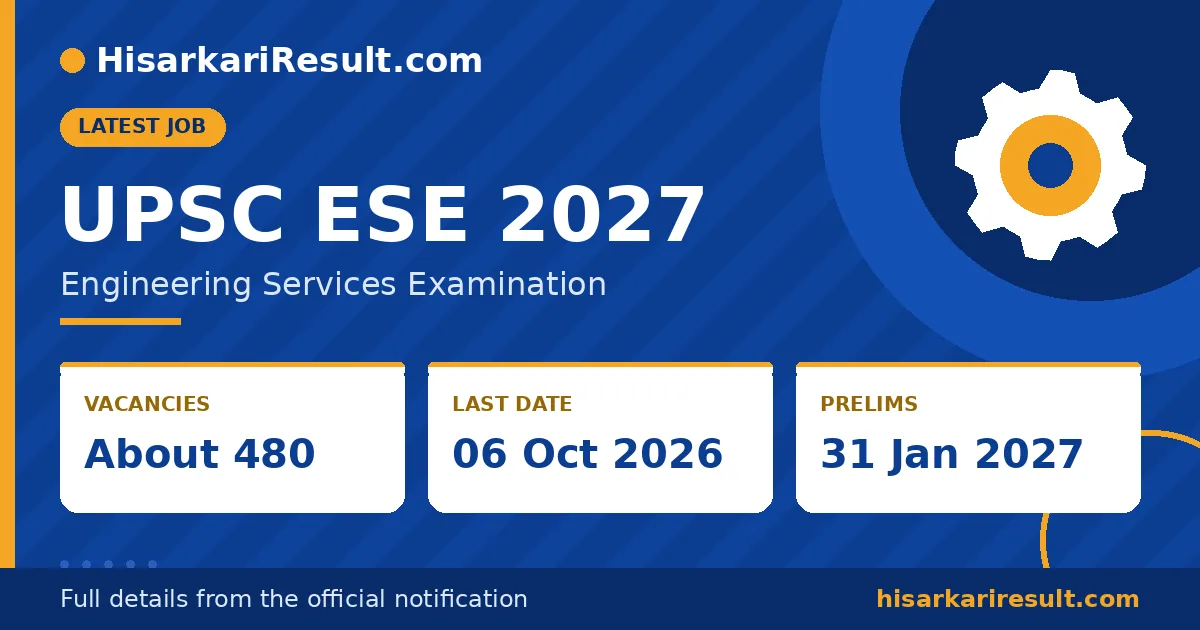
UPSC ESE 2027 Notification: Overview
| Item | Details |
|---|---|
| Conducting body | Union Public Service Commission (UPSC) |
| Examination | Engineering Services Examination, 2027 |
| Notice number | 02/2027-ENGG. (File No. F.02/02/2026-E.1B) |
| Expected vacancies | About 480 (including 19 for PwBD) |
| Engineering categories | Civil, Mechanical, Electrical, Electronics & Telecommunication |
| Application window | 16.09.2026 to 06.10.2026 (6:00 PM) |
| Preliminary (Stage-I) | 31.01.2027 |
| Main (Stage-II) | 18.06.2027 |
| Age limit | 21 to 30 years as on 01.01.2027 |
| Fee | Rs 200 (Female/SC/ST/PwBD exempted) |
| Apply at | https://upsconline.nic.in |
| Official website | https://upsc.gov.in |
The exam is held under the Rules published by the Department of Telecommunications, Ministry of Communications, in the Gazette of India (Extraordinary) on 16 September 2026. You may apply in only one of the four engineering categories. Services and posts are allotted strictly by your merit position, your preferences and the vacancies available, subject to medical fitness.
Applying is a four-part process on the UPSC portal: Account Creation, Universal Registration Number (URN), the Common Application Form (CAF), and the exam-specific module, which covers fee, centre and discipline. A URN is created once in a lifetime and is used for every UPSC exam. The application number changes with each exam.
UPSC ESE 2027 Important Links
Official Notification PDF (English)
upsc.gov.in
Click Here →Apply Online (UPSC Online Application Portal)
upsconline.nic.in
Click Here →Official Website (UPSC)
upsc.gov.in
Click Here →UPSC ESE 2027 Important Dates
Note: There is no correction window in this notice. Once you submit the application, you cannot withdraw it or change any field. UPSC offers only a one-time edit of the URN profile, which applies to applications submitted after you edit and re-lock it.
UPSC ESE 2027 Application Fee
| Category | Fee |
|---|---|
| General / OBC / EWS (male) | Rs 200 |
| Female candidates (all categories) | Exempted |
| SC / ST | Exempted |
| Persons with Benchmark Disability | Exempted |
Pay through net banking, a Visa, MasterCard or RuPay credit or debit card, or UPI. OBC and EWS candidates get no fee exemption. The fee is not refunded and cannot be held over for another exam. Applications without the fee are rejected, unless a fee exemption is claimed.
UPSC ESE 2027 Age Limit and Age Relaxation
You must be at least 21 and under 30 on 01.01.2027, meaning born between 02.01.1997 and 01.01.2006. UPSC accepts only the date of birth in your Matriculation or Secondary School Leaving Certificate, or an equivalent certificate. It will not allow any later change.
| Category | Relaxation in upper age limit |
|---|---|
| Scheduled Caste / Scheduled Tribe | Up to 5 years |
| Other Backward Classes (eligible for reservation) | Up to 3 years |
| Defence Services personnel disabled in operations during hostilities or in a disturbed area and released as a result | Up to 3 years |
| Ex-Servicemen, including Commissioned Officers and ECOs/SSCOs, with at least 5 years' military service as on 01.01.2027 and released as specified | Up to 5 years |
| ECOs/SSCOs whose 5-year assignment has been extended and who hold the Ministry of Defence certificate | Up to 5 years |
| PwBD (Low Vision, Deaf and Hard of Hearing, Locomotor Disability including Leprosy cured, Dwarfism, Acid Attack victims, Muscular Dystrophy, SLD and Mental Illness) | Up to 10 years |
| Government servants in the listed departments (permanent post holders, or 3 years' continuous regular temporary service as on 01.01.2027) | Upper limit relaxable to 35 years, for the services of that department |
SC/ST/OBC candidates who are also Ex-Servicemen or PwBD can combine both relaxations. Departmental candidates admitted under the age concession lose their candidature if they resign or are terminated after applying, but not if they are retrenched. The departments covered include CPWD, MoRTH, DoT, DGAQA, the Survey of India, BRO, the Indian Navy, MES, the Central Water Commission, the Central Electricity Authority, the Ministry of Skill Development, GSI and the Ministry of Railways, as listed in the notice.
UPSC ESE 2027 Vacancy Details
| Item | Number |
|---|---|
| Total expected vacancies | About 480 |
| PwBD vacancies (included in total) | 19 |
| – Locomotor Disability (incl. Leprosy cured, Dwarfism, Acid Attack victims, Muscular Dystrophy) | 11 |
| – Hard of Hearing | 6 |
| – Low Vision | 1 |
| – SLD and MD | 1 |
| Category-wise (UR/SC/ST/OBC/EWS) and service-wise split | Check official notification |
The number of vacancies may change. Reservation for SC, ST, OBC, EWS and PwBD will be as fixed by the Government of India. Candidates with blindness are advised not to apply, because no vacancies are identified for them. Low Vision candidates should apply only for services they are eligible for under Annexure-I (Functional Classification and Physical Requirements).
Participating services
| Category | Services / posts |
|---|---|
| I – Civil Engineering (Group A) | Central Engineering Service; Central Engineering Service (Roads) Gr A; Survey of India Gr A Service; AEE (Civil) in Border Roads Engineering Service; AEE (QS&C) in MES Surveyor Cadre; Central Water Engineering (Gr A) Service; Indian Skill Development Service; IRMS (Civil); IRMS (Stores) – Civil Engg. Posts; Indian Defence Service of Engineers |
| II – Mechanical Engineering (Group A/B) | AEE in GSI Engineering Service Gr A; Indian Naval Material Management Service (Mech.); DAQAS/SSO-II (Mech.); AEE (E&M) in Border Roads Engineering Service (Mech.); Indian Skill Development Service; IRMS (Mechanical); IRMS (Stores) – Mech. Engg. Posts; Indian Defence Service of Engineers; Indian Naval Armament Service (Mech.); Central Water Engineering (Gr A) Service; Central Electrical and Mechanical Engineering Service (Mech.); Central Power Engineering Service Gr A (Mech.) |
| III – Electrical Engineering (Group A/B) | Central Electrical & Mechanical Engineering Service (Elec.); Indian Naval Material Management Service (Elec.); Central Power Engineering Service Gr A (Elec.); DAQAS/SSO-II (Elec.); Indian Skill Development Service; IRMS (Electrical); IRMS (Stores) – Elec. Engg. Posts; Indian Defence Service of Engineers; Indian Naval Armament Service (Elec.) |
| IV – Electronics & Telecommunication Engineering (Group A/B) | Indian Radio Regulatory Service Gr A; Indian Telecommunications Service Gr A; Indian Naval Material Management Service (E&T); Indian Naval Armament Service (E&T); Indian Skill Development Service; Junior Telecom Officer Gr B; IRMS (Signal & Telecommunication); IRMS (Stores) – S&T Engg. Posts; Central Power Engineering Service Gr A (E&T) |
The eligibility of transgender candidates for AEE (Civil) and AEE (E&M) (Mechanical Engg. Posts) in the Border Roads Engineering Service will follow a government decision to be taken later.
UPSC ESE 2027 Eligibility Criteria
Nationality
You must be a citizen of India; a subject of Nepal or Bhutan; a Tibetan refugee who came to India before 1 January 1962 to settle permanently; or a person of Indian origin who migrated from Pakistan, Burma, Sri Lanka, Kenya, Uganda, Tanzania, Zambia, Malawi, Zaire, Ethiopia or Vietnam to settle permanently. Every group except Indian citizens needs a Government of India eligibility certificate before an offer of appointment.
Educational qualification
- A degree in Engineering from a university set up by a Central or State Act, an institution set up by an Act of Parliament, or a deemed university under Section 3 of the UGC Act, 1956; or
- Sections A and B of the Institution Examinations of the Institution of Engineers (India); or
- An engineering degree or diploma from a foreign university or institution recognised by the Government; or
- The Graduate Membership Examination of the Institution of Electronics and Telecommunication Engineers (India); or
- Associate Membership Examination Parts II and III / Sections A and B of the Aeronautical Society of India; or
- The Graduate Membership Examination of the Institution of Electronics and Radio Engineers, London, held after November 1959.
For the Indian Naval Armament Service (Electronics Engg. Posts) and the Indian Radio Regulatory Service Gr A, certain M.Sc. degrees (with Wireless Communication Electronics, Radio Physics or Radio Engineering, or Physics with Radio Communication/Electronics/Telecommunication) are also accepted.
Important: IETE and Aeronautical Society of India qualifications where admission was taken after 31.05.2013 are not accepted for ESE 2027. For Institution of Engineers (India) qualifications with admission after 31.05.2013, eligibility depends on the government's decision following the Delhi High Court judgment. Final-year candidates may apply, but if they qualify for the interview they must upload proof of passing within 10 days of the Main result.
Medical and physical standards
Candidates finally recommended must pass a medical examination arranged by the Department of Telecommunications. Physical standards follow Appendix-II of the ESE 2027 Rules.
UPSC ESE 2027 Selection Process
- Stage-I: Preliminary Examination. Two objective papers worth 500 marks. It screens candidates for the Main exam, and its marks also count in the final merit.
- Stage-II: Main Examination. Two conventional (written) papers in your engineering discipline, worth 600 marks. About six to seven times the number of vacancies are admitted.
- Stage-III: Personality Test / Interview. 200 marks, with no minimum qualifying marks. About twice the number of vacancies are called.
Final ranking uses the total of Stage-I, Stage-II and Stage-III marks. Ties are broken first by the combined marks in the three discipline papers plus the interview, then by the three discipline papers alone, then by age (older first). After that, UPSC decides. Marks are rounded to two decimal places at every stage.
UPSC ESE 2027 Exam Pattern
Stage-I (Preliminary) – Objective
| Paper | Subject | Duration | Maximum marks |
|---|---|---|---|
| Paper-I | General Studies and Engineering Aptitude (common to all) | 2 hours | 200 |
| Paper-II | Engineering discipline (Civil / Mechanical / Electrical / E&T) | 3 hours | 300 |
| Total | 500 | ||
Each question has four options. A wrong answer, or marking more than one answer, costs one-third of the marks for that question. Unanswered questions carry no penalty. Calculators are not allowed in the objective papers.
Stage-II (Main) – Conventional
| Paper | Subject | Duration | Maximum marks |
|---|---|---|---|
| Paper-I | Engineering discipline | 3 hours | 300 |
| Paper-II | Engineering discipline | 3 hours | 300 |
| Total | 600 | ||
Stage-III
| Stage | Marks | Minimum qualifying |
|---|---|---|
| Personality Test / Interview | 200 | None |
Conventional papers are set and answered in English. Non-programmable battery-operated pocket calculators are allowed only in the conventional papers. Up to 5% of the maximum marks may be deducted for illegible handwriting. SI units are used, and UPSC supplies standard tables where needed. The interview judges leadership, initiative, intellectual curiosity, tact, mental and physical energy, practical application and integrity of character.
UPSC ESE 2027 Syllabus (Brief)
The Paper-I standard is that of an engineering or science graduate. The engineering papers are at roughly engineering degree level.
Paper-I: General Studies and Engineering Aptitude (Prelims)
- Current issues of national and international importance relating to social, economic and industrial development.
- Engineering aptitude (logical reasoning and analytical ability), engineering mathematics and numerical analysis.
- General principles of design, drawing and safety. Standards and quality practices.
- Energy and environment basics, project management, material science, ICT tools in engineering, and ethics in the engineering profession.
All 10 topics will be covered, each worth 5% to 15% of the paper's marks.
Civil Engineering
- Paper-I: building materials, solid mechanics, structural analysis, design of steel structures, design of concrete and masonry structures, construction practice, planning and management.
- Paper-II: flow of fluids, hydraulic machines and hydropower; hydrology and water resources; environmental engineering; geotechnical and foundation engineering; surveying and geology; transportation engineering.
Mechanical Engineering
- Paper-I: fluid mechanics, thermodynamics and heat transfer, IC engines, refrigeration and air conditioning, turbo machinery, power plant engineering, renewable sources of energy.
- Paper-II: engineering mechanics, engineering materials, mechanisms and machines, design of machine elements, manufacturing, industrial and maintenance engineering, mechatronics and robotics.
Electrical Engineering
- Paper-I: engineering mathematics, electrical materials, electric circuits and fields, electrical and electronic measurements, computer fundamentals, basic electronics engineering.
- Paper-II: analog and digital electronics, systems and signal processing, control systems, electrical machines, power systems, power electronics and drives.
Electronics & Telecommunication Engineering
- Paper-I: basic electronics engineering, basic electrical engineering, materials science, electronic measurements and instrumentation, network theory, analog and digital circuits.
- Paper-II: analog and digital communication systems, control systems, computer organisation and architecture, electromagnetics, advanced electronics topics, advanced communication topics.
In each discipline, the Prelims Paper-II draws on the combined content of Main Papers I and II. See the notice for the full sub-topics.
UPSC ESE 2027 Salary / Pay Scale
| Service group | Pay scale |
|---|---|
| Group A services | Check official notification |
| Group B posts (e.g. Junior Telecom Officer Gr B) | Check official notification |
The examination notice does not give pay levels or salaries for the participating services. Refer to the ESE 2027 Rules or the cadre-controlling authorities.
Examination Centres
The Preliminary exam will be held at 48 centres: Agartala, Ahmedabad, Aizawl, Aligarh, Prayagraj (Allahabad), Bangalore, Bareilly, Bhopal, Chandigarh, Gurugram, Chennai, Cuttack, Dehradun, Delhi, Dharwad, Dispur (Guwahati), Gangtok, Hyderabad, Imphal, Agra, Itanagar, Jaipur, Jammu, Jorhat, Kochi (Cochin), Kohima, Kolkata, Lucknow, Madurai, Gaya, Mumbai, Nagpur, Panaji (Goa), Patna, Port Blair, Raipur, Ranchi, Sambalpur, Shillong, Gorakhpur, Shimla, Srinagar, Thiruvananthapuram, Tirupati, Udaipur, Visakhapatnam, Ghaziabad and Varanasi.
The Main exam will be held at 24 centres: Ahmedabad, Aizawl, Prayagraj (Allahabad), Bangalore, Bhopal, Chandigarh, Chennai, Cuttack, Dehradun, Delhi, Dispur (Guwahati), Hyderabad, Jaipur, Jammu, Kolkata, Lucknow, Mumbai, Patna, Raipur, Ranchi, Shillong, Shimla, Thiruvananthapuram and Visakhapatnam.
Every centre except Chennai, Dispur, Kolkata and Nagpur has a seat limit. Centres are allotted first-apply-first-allot, so applying early improves your chance of getting the centre you want. Requests to change centres are not accepted.
How to Apply for UPSC ESE 2027
- Go to https://upsconline.nic.in and create an account if you do not have one.
- Generate your Universal Registration Number (URN). Enter the details of one photo ID (Aadhaar is strongly recommended), which you must carry to the exam.
- Fill in the Common Application Form (CAF). Upload a photograph and also capture a live photo. Sign three times, one below the other, on white paper in black ink and upload it. Photo and signature files must be JPG, 20 KB to 300 KB each.
- Enter your name, father's name, mother's name and date of birth exactly as in your Matriculation certificate.
- Open the ESE 2027 exam-specific module. Choose your engineering category (only one) and your Prelims centre, and give consent for the Pratibha Setu scheme if you wish.
- Pay Rs 200 online, unless you are exempt.
- Review every field, then submit by 06.10.2026, 6:00 PM. Submitted forms cannot be withdrawn or edited.
- Government employees must inform their Head of Office or Department that they have applied.
Note: You do not need to send a printout to UPSC. Use a valid e-mail ID, and add @nic.in addresses to your safe list so UPSC mail does not land in spam.
Documents Required for UPSC ESE 2027
- Matriculation / Secondary School certificate (age proof)
- Engineering degree or other qualifying certificate, or proof of passing if you are in the final year
- SC/ST/OBC/EWS certificate, where applicable. The OBC (NCL) certificate must be based on income for FY 2023-24, 2024-25 and 2025-26. EWS Income and Asset certificates must be based on FY 2025-26 income. Both must be issued between 01.04.2026 and 06.10.2026
- Certificate for any age or fee concession claimed
- Disability certificate in the prescribed format (Forms V–VII under the MSJE notification of 15.06.2017), for PwBD
- Photo ID (Aadhaar, Voter ID, PAN, passport, driving licence, or a government-issued ID)
- Scanned photograph and triple signature
Originals must be produced at the Personality Test.
Common Mistakes to Avoid
- Choosing the wrong engineering category. You get only one, and papers written in a different discipline will not be evaluated.
- Waiting too long and finding your preferred centre already full.
- Entering a date of birth that differs from the Matriculation certificate.
- Uploading a single signature instead of three, or an unclear live photo.
- Bringing a mobile phone, smart watch or AI-enabled glasses into the exam hall. These are banned and can lead to debarment.
- Arriving late. Entry closes 30 minutes before each session, and face authentication is compulsory.
Preparation Tips
- Prelims marks count in the final merit, so aim for a high score, not just the cut-off.
- Cover all 10 General Studies and Engineering Aptitude topics, since each carries 5–15% of Paper-I.
- Answer only when reasonably sure, because each wrong answer costs one-third of the question's marks.
- For the Main exam, practise writing structured, concise answers with clear diagrams. Credit goes to orderly, exact expression.
- Prepare for the interview by reviewing your projects and current engineering developments.
Frequently Asked Questions
How many vacancies are there in UPSC ESE 2027?
About 480, including 19 for Persons with Benchmark Disabilities. The number may change.
What is the last date to apply for ESE 2027?
06.10.2026, until 6:00 PM, on https://upsconline.nic.in.
When is the ESE 2027 Prelims?
31 January 2027. The Main exam is on 18 June 2027.
What is the age limit?
21 to 30 years as on 01.01.2027, with relaxations for SC/ST (5 years), OBC (3 years), PwBD (10 years), certain Ex-Servicemen and eligible government servants.
What is the application fee?
Rs 200. Female, SC, ST and PwBD candidates are exempt. OBC and EWS candidates must pay.
Can final-year engineering students apply?
Yes, provisionally. If they qualify for the interview, they must upload proof of passing within the 10-day window after the Main result.
How many engineering branches can I choose?
Only one of Civil, Mechanical, Electrical, or Electronics & Telecommunication.
Is there negative marking in ESE Prelims?
Yes. One-third of the marks for a question are deducted for each wrong answer. Unanswered questions carry no penalty.
What are the total marks in ESE 2027?
Prelims 500 + Main 600 + Interview 200 = 1,300 marks, all counted in the final ranking.
Can I use a calculator in the exam?
Only non-programmable pocket calculators, and only in the conventional (Main) papers. Calculators are not allowed in the objective papers.
Can I correct my form after submission?
No. You cannot change or withdraw an application after submitting it. Only the URN profile has a one-time edit option.
Are AMIE qualifications accepted?
Sections A and B of the Institution of Engineers (India) are accepted. For admissions after 31.05.2013, eligibility depends on the government's decision after the Delhi High Court judgment.
Who should not apply under PwBD?
Candidates with blindness are advised not to apply, because no ESE 2027 services are identified for them.
What is the UPSC helpline for application issues?
011-24041001 / 011-40303444 or upscsoap@nic.in, from 10:00 AM to 5:30 PM on working days during the application period.
ESE 2027 offers about 480 engineering posts in central Group A and B services. The application deadline is 6 October 2026 at 6:00 PM, and Prelims are on 31 January 2027. Choose your discipline and centre with care, keep your certificates ready in the required formats, and check upsc.gov.in for admit cards and results. For anything not covered here, follow the official UPSC notice.